Become a member of the UCCI
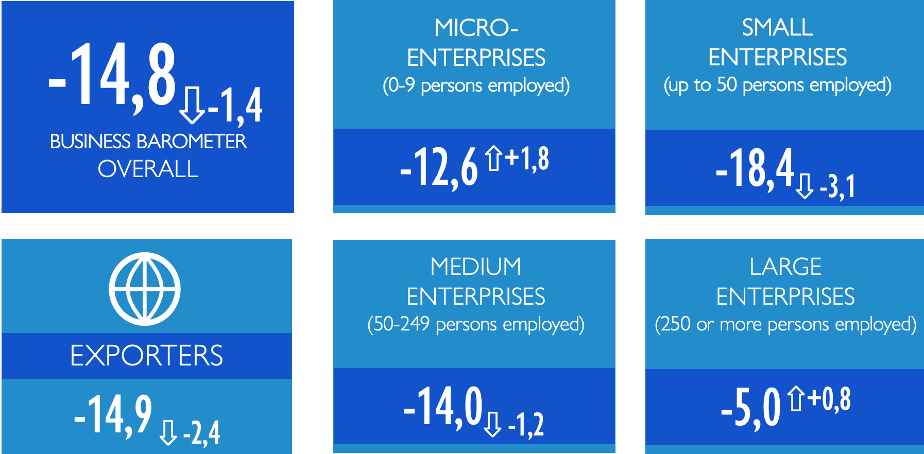
In September 2026, the overall Business Barometer Index continued to decline, falling to -14.8 (↓1.4) and reaching its lowest level in the past year.
Pessimistic sentiment prevails across all four sectors, with predominantly moderate negative dynamics. The greatest challenges are observed in manufacturing (-19.8 ↓3.4) and services (-13.9 ↓4.7). Businesses in trade (-11.9 ↑3.8) perceive the situation somewhat more positively. Construction (-4.8 ↓2.7) continues to perform better than the other sectors
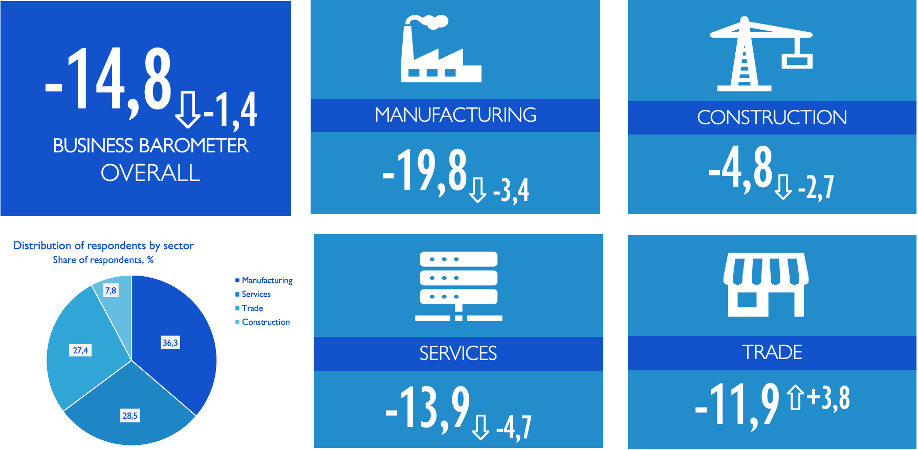
Negative expectations dominate across all business size categories, regardless of company size. The outlook shows some improvement only among microenterprises (-12.6 ↑1.8) and large enterprises (-5.0 ↑0.8). Among small (-18.4 ↓3.1) and medium-sized enterprises (-14.0 ↓1.2), pessimistic expectations about the future have become more pronounced.
Exporters’ expectations are slightly more cautious than those of the business community overall, at -14.9 (↓2.4).
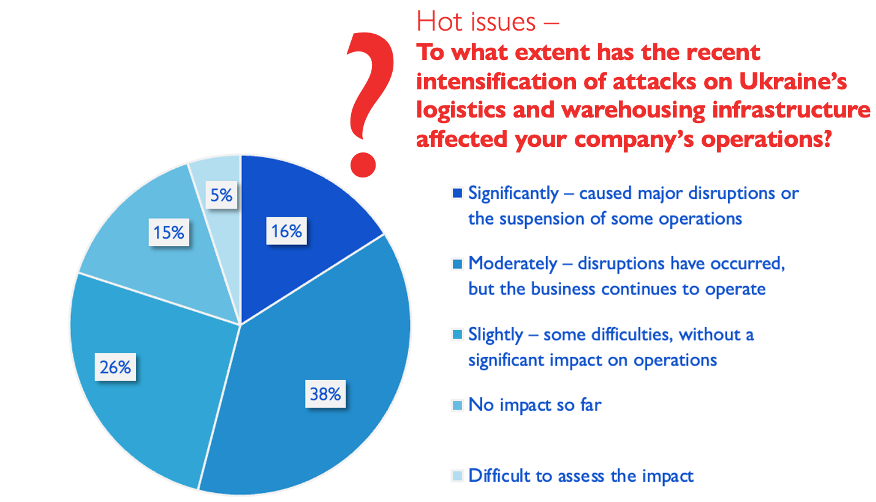
Survey results on the impact of intensified attacks on logistics and warehousing infrastructure on business operations indicate that the majority of enterprises have experienced negative effects. For 16% of respondents, the impact was significant, while 38% reported a moderate impact. A further 26% experienced minor disruptions. Only 15% have so far reported no impact.
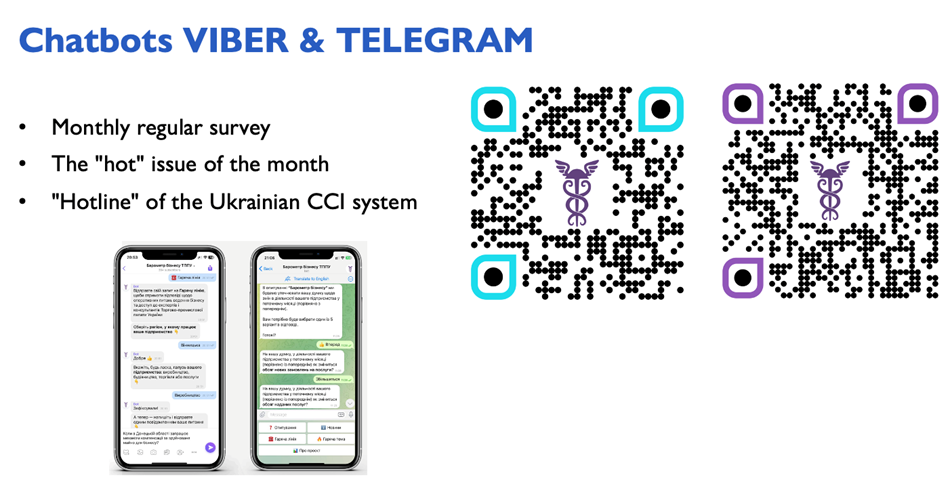
Monthly, in addition to the regular survey, respondents can answer the “hot” question of the month and contact the hot line of the Ukrainian Chamber of Commerce and Industry.
The survey is conducted in verified chatbots on Telegram and Viber and takes only 2 minutes.
Access to the September 2026 report is here.
About the “Business Barometer”
The Business Barometer from the Ukrainian Chamber of Commerce and Industry (UCCI) reflects the views of enterprises and entrepreneurs who are members and partners of the UCCI. It shows expectations regarding changes in the business environment for the upcoming month compared to the previous one.
It is based on a survey that takes into account the status of indicators (“sub-indices”) of respondents’ activities in four sectors (manufacturing, construction, trade, services). The Business Barometer is adapted to the needs of members and partners of the UCCI. A unique feature of the
Business Barometer is the inclusion of specialized sectoral questions and an analysis of the state of exports, providing an additional perspective on market conditions.
The main goal of the Index is to provide enterprises and entrepreneurs who are members and partners of the UCCI with a simple and accessible tool for assessing changes in the business environment in Ukraine.
The Business Barometer value of 0 points indicates no change in expectations. A value above 0 suggests that businesses anticipate an improvement in economic trends compared to the previous month. A value below 0 reflects negative expectations regarding changes relative to the prior month.
This publication was created by the Ukrainian Chamber of Commerce and Industry within the framework of the project "Transformational Recovery for People's Security in Ukraine," funded by the Government of Japan and implemented by the United Nations Development Programme (UNDP) in Ukraine.
The opinions, statements, conclusions, or recommendations expressed in this document belong to the authors and do not necessarily reflect the views of UNDP, the United Nations, the Government of Japan, and/or other international partners.